Understanding the key differences between Granite, Quartz and Quartzite can make it easier to identify the surface that best complements your space and design preferences.
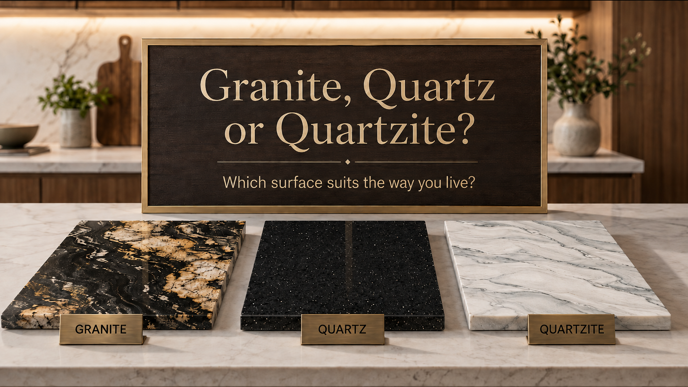
Rather than asking which one is universally “best”, a better question may be: Which surface best suits the way you live and the space you want to create?
First, What Is the Difference?
The main difference is simple: Granite and Quartzite are natural stones, while Quartz is an engineered surface.
-
- Granite is a natural stone known for its durability, mineral patterns and individual character.
- Quartz is an engineered surface made from quartz and/or other mineral fillers combined with resins, pigments and additives. Its controlled manufacturing process allows for greater consistency in colour and pattern.
- Quartzite is a natural metamorphic stone known for its distinctive veining, natural variation and, in true geological quartzite, high hardness.
These differences influence not only how each surface looks, but also how it can shape the overall character of a space.
If You Prefer a Consistent Look
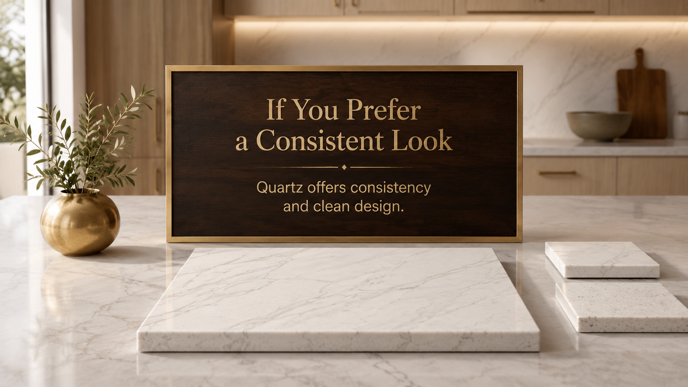
Some homeowners prefer a clean, coordinated interior where the countertop works seamlessly with cabinetry, flooring and other finishes.
In this case, Quartz may be particularly appealing. Because it is engineered, Quartz generally offers:
-
- More consistent colours and patterns
- Greater consistency between slabs
- A wide selection of contemporary designs
This can make it easier to coordinate the surface with the overall interior palette.
For minimalist, modern or highly coordinated spaces, this consistency can be an advantage.
If You Want Something Naturally Unique
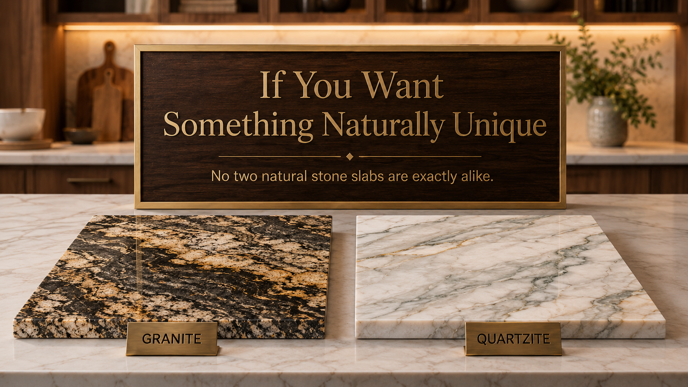
For others, the beauty of a surface lies in the fact that it cannot be exactly replicated. This is where natural stone stands apart.
Every Granite and Quartzite slab has its own natural characteristics, including variations in:
-
- Colour
- Veining
- Mineral patterns
- Movement
- Texture
No two slabs are exactly alike.
Granite
Granite often features distinctive mineral patterns and natural movement, giving the surface depth and individuality. It is particularly suitable for homeowners who appreciate the authentic character of natural stone.
Quartzite
Quartzite can display striking veining and dramatic colour movement, making it especially attractive when the surface itself is intended to become a design feature.
If you value natural variation and individuality, Granite or Quartzite may appeal more strongly than an engineered surface.
If You Want a Statement Kitchen Island
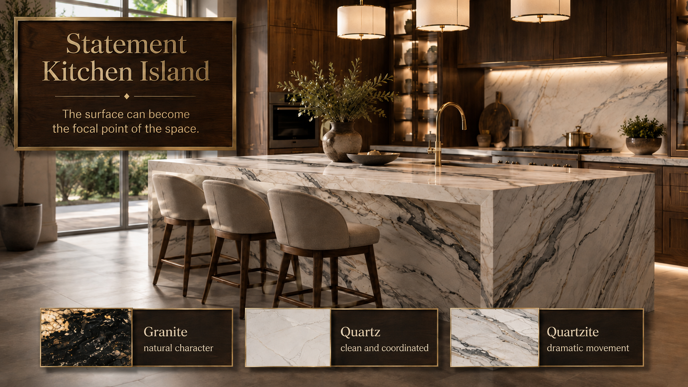
For many homes, the kitchen island is more than a preparation area. It can also become one of the main visual features of the space.
Quartzite can be especially effective for statement islands because of its distinctive natural veining and movement. A dramatic slab can continue across a waterfall edge or backsplash to create greater visual continuity.
Granite can provide a different type of natural character, often with more mineral-rich patterns and texture.
Quartz offers another approach, with greater consistency and more controlled designs.
A simple way to think about it:
Natural character and texture → Granite
Clean and coordinated → Quartz
Dramatic natural movement → Quartzite
The right choice depends on the effect you want the surface to create within the overall design.
If You Want to Use the Surface Beyond the Kitchen
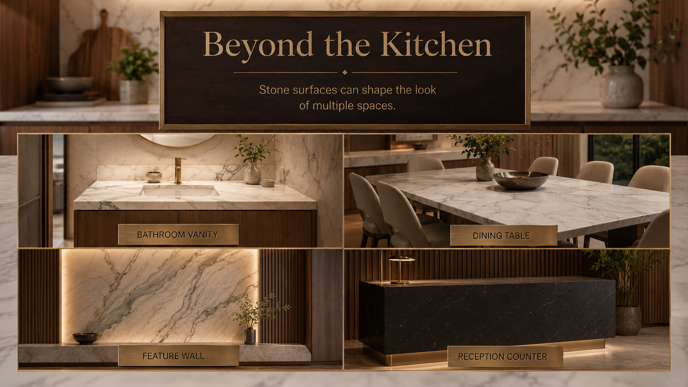
Granite, Quartz and Quartzite are not limited to kitchen countertops. Depending on the material and technical requirements, they can also be considered for applications such as:
-
- Bathroom vanity tops
- Dining tabletops
- Feature walls
- Reception counters
- Commercial interiors
- Selected architectural applications
Using the same or complementary material in different areas can create a stronger sense of continuity throughout the space.
Granite
Granite can be considered for various interior applications and, depending on the particular stone and technical requirements, selected exterior applications.
Quartz
Quartz is well suited to a wide range of interior applications, particularly where consistency and easy everyday care are important.
Quartzite
Quartzite works particularly well where natural stone is intended to make a visual statement, including islands, feature walls, vanity tops, tabletops and selected architectural applications.
If the Surface Will Be Used Outdoors
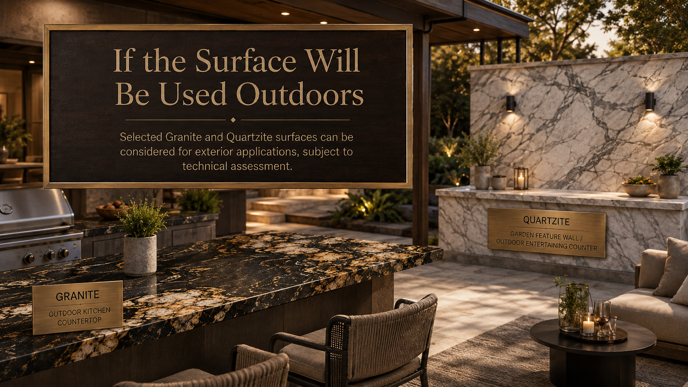
Outdoor applications require additional consideration, particularly in Singapore’s tropical climate.
Granite and Quartzite
Some Granite and Quartzite models can be suitable for selected exterior applications, subject to technical assessment.
Suitability will depend on factors such as:
-
- The particular stone
- Surface finish
- Environmental exposure
- Intended application
- Installation or fixing system
For exterior projects, material selection should therefore consider both design and technical suitability.
Quartz
Quartz is generally better suited to interior applications. Because it contains resin binders, prolonged UV exposure and changing weather conditions may affect some engineered Quartz products.
If Quartz is being considered for an exterior application, the specific product should first be confirmed as suitable and approved by its manufacturer.
Natural or Engineered: Which Do You Prefer?
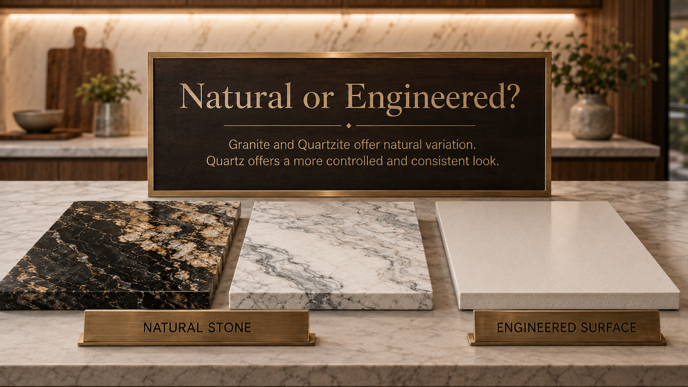
Sometimes the decision becomes easier when viewed from one simple perspective:
Do you prefer the individuality of natural stone or the predictability of an engineered surface?
Choose Natural Stone If You Appreciate Variation
Granite and Quartzite are naturally formed. Colour movement, veining, mineral characteristics and other variations are part of their natural character. For many homeowners, this individuality is precisely what makes natural stone special.
Choose Quartz If You Prefer Consistency
Quartz provides greater control over colour and pattern. This makes it easier to achieve a more uniform and coordinated interior, particularly where the countertop is intended to complement rather than dominate the overall design.
Neither approach is better. They simply create different experiences.
Granite vs Quartz vs Quartzite: A Quick General Design Guide
|
If this matters most to you: |
Consider: |
|
1) Consistent colour and pattern |
Quartz |
|
2) Non-porous surface |
Quartz |
|
3) Natural character or dramatic appearance |
Granite / Quartzite |
|
4) Selected exterior applications |
Granite / Quartzite* |
-
- Suitability depends on the specific product or material, intended application, environmental exposure and technical assessment.
See, Touch and Experience the Surface Before You Decide
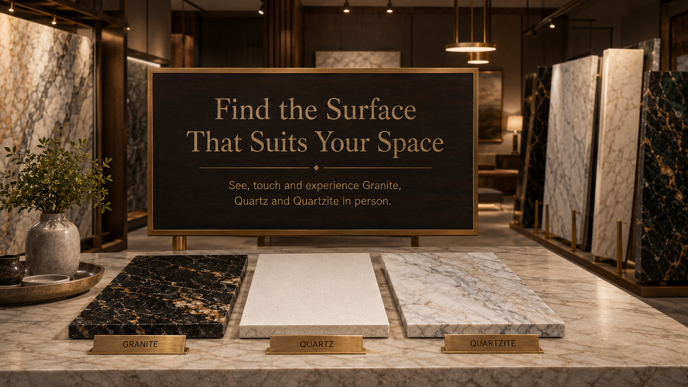
There is no universal winner when comparing Granite vs Quartz vs Quartzite.
Ultimately, the right surface is not simply the one that performs best on paper.
It is the one that best suits your space, your design preferences and the way you want to live with it.
Even within the same category of natural stone, individual slabs can vary significantly in colour, veining and overall character. This is particularly important when selecting Granite or Quartzite.
A photograph or small sample may show the general colour, but it may not fully capture the movement and character of an entire slab.
Viewing the actual material can therefore help you understand how the surface will look across a full countertop, island or feature wall.
For Quartz, viewing larger samples can similarly help you appreciate the scale and direction of the pattern.
Visit the Lian Hin Gallery to see, touch and experience Granite, Quartz and Quartzite in person, and find the surface that best suits your space and design vision.
Disclosure: This article includes AI-generated imagery.
